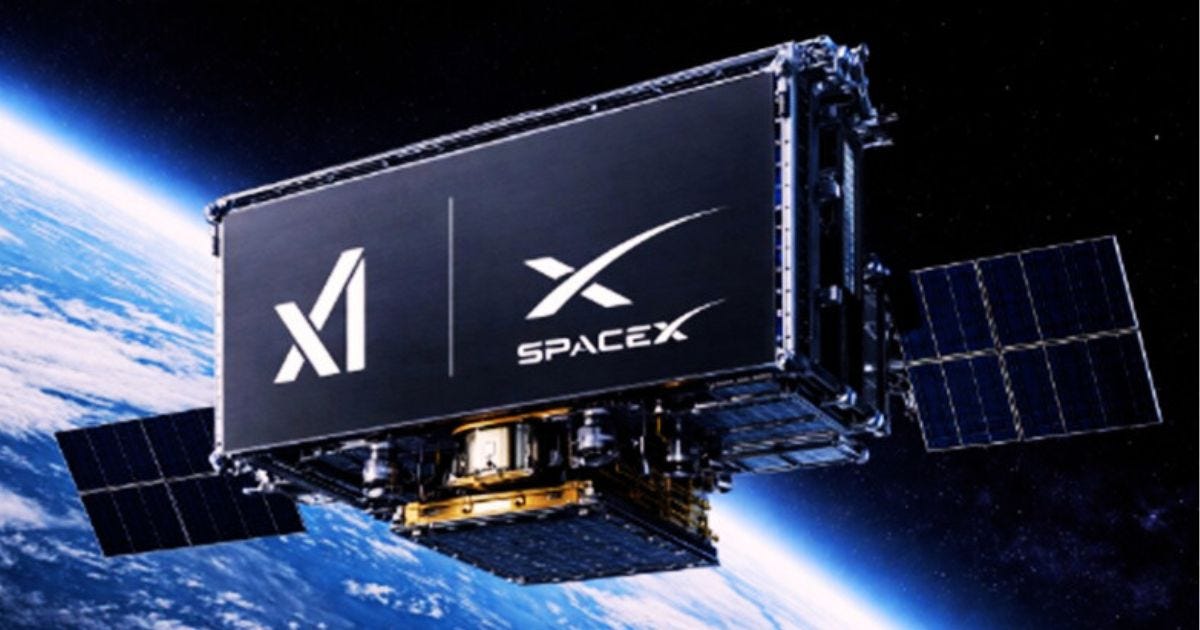
Funding Secured
The logic behind the $1.25 trillion SpaceX + xAI merger

From the SpaceX announcement:
SpaceX has acquired xAI to form the most ambitious, vertically-integrated innovation engine on (and off) Earth, with AI, rockets, space-based internet, direct-to-mobile device communications and the world’s foremost real-time information and free speech platform.
What’s really interesting is the narrative used to explain the merger:
Current advances in AI are dependent on large terrestrial data centers, which require immense amounts of power and cooling. Global electricity demand for AI simply cannot be met with terrestrial solutions, even in the near term, without imposing hardship on communities and the environment … In the long term, space-based AI is obviously the only way to scale.
I can’t help but point out that this puts an end to the Twitter/X saga that dominated business news in 2022. Props to the people who predicted that SpaceX would own Twitter (now X) a mere three-and-a-half-years later. Here’s how Bloomberg’s Matt Levine sees the logic for the merger:
The combination here is not so much “use SpaceX’s revenue to fund xAI’s capital needs” as it is “use SpaceX’s fundraising ability to fund xAI’s capital needs.” There are a lot of money-hungry AI companies these days, but only one money-hungry rocket company that also does AI.
Much of the other commentary on the merger echoed this opinion. The merger was driven by xAI’s funding needs. But who wouldn’t use SpaceX’s fundraising capability to bring in vast sums of funding at a lower cost of capital? It makes sense to me. I would hazard a guess Matt Levine would do the same too if he was in Elon’s position.
I differ a little in that I believe SpaceX’s fundraising capability plus the vast profits from SpaceX’s Starlink business will fund the ventures. According to Payload Space, Starlink will generate $18.7 billion in 2026, and it is rumored to have 50%+ margins.
Cue the speculation on when Tesla will merge with SpaceX.
Please “Like ♥️” this piece!